 BeDRY
BeDRY
This case is fictional. It is constructed by Dr. Slaven Abdović from common presentations seen in an incontinence clinic. The screenshots use diaries created specifically for these examples; no real patient data is used. Any resemblance to a real person is entirely coincidental. The interpretation reflects his clinical experience alongside published guidelines. The example is educational and not a substitute for assessment by your own doctor.
In short
- Wet every night since potty training, never a dry stretch of any length. No daytime symptoms, normal stools, normal urine tests.
- Three nights of diary, including two measured night-time voids and the first morning pee.
- Bladder capacity turned out to be normal for age. Night-time urine production was far above it — 260 ml made overnight against a bladder that holds about 180 ml.
- BeDRY Checkpoint helped make sense of the diary findings, while Coach turned them into practical drinking and toilet habits the family could follow at home alongside any treatment recommended by their doctor.
What the parents described
A five-year-old boy, wet every night. Since potty training there has never been a six-month stretch of dry nights — not even a single dry week. He sleeps deeply and never wakes on his own during the night. While he is awake he has no leaks and no urgency at all, and his parents describe his stools as normal. Urine analysis was normal: no glucose, no protein, no leukocytes.
This is a common way bedwetting presents in a clinic. By the age of five, bedwetting is no longer considered simply part of normal maturation; it is a clinical condition that should be addressed. To treat it successfully, we need to understand why it is happening in this particular child. The first step is a bladder diary.
The diary
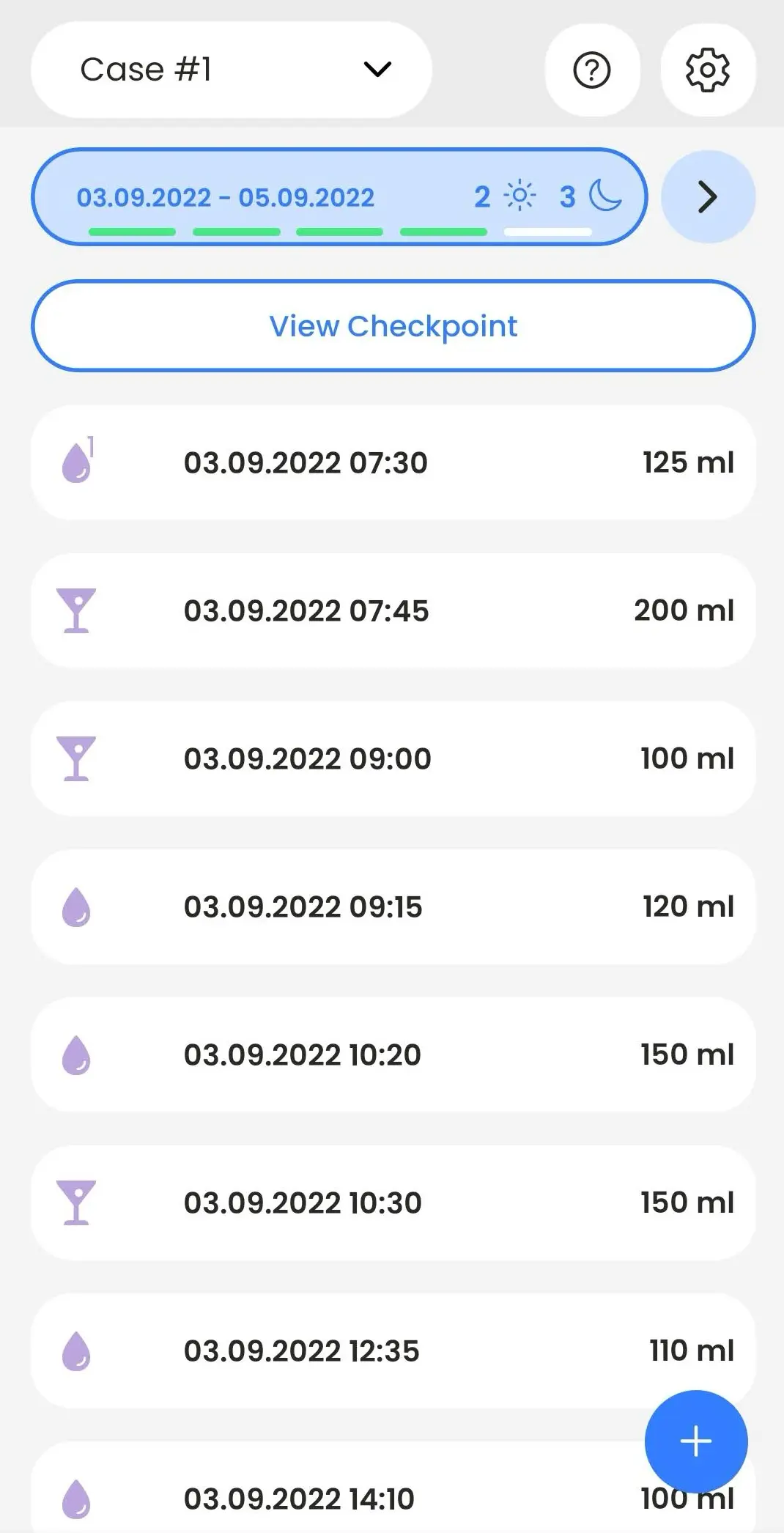
The family recorded two days and three nights. To measure night-time urine production, the parents recorded two night-time voids — about one hour and four hours after he fell asleep — and added the first morning pee. That is a demanding two days. It is also enough to answer the question.
What the summary showed
The summary is where the diary stops being a list and starts being an answer. BeDRY automatically calculates these measurements from the diary, turning individual entries into a clear summary for the family and their doctor.
| Expected bladder capacity for age | 180 ml |
| Largest measured void | 175 ml (97%) |
| Night-time urine production | 260 ml (144%) |
| Mismatch between the two | 85 ml |
| Total daily fluid intake | 1250 ml |
| Fluid intake after 7 PM | 200 ml |
| Voids per day | 10 |
| Longest daytime interval between voids | 2 h 30 min |
| Overactivity index | −5 |
Two numbers matter here. The largest measured urination volume, 175 ml, is 97% of the 180 ml expected for his age — the bladder is a normal size. Yet the kidneys produced 260 ml overnight, 144% of what that bladder can hold. That is 85 ml more urine than the bladder can store until morning.
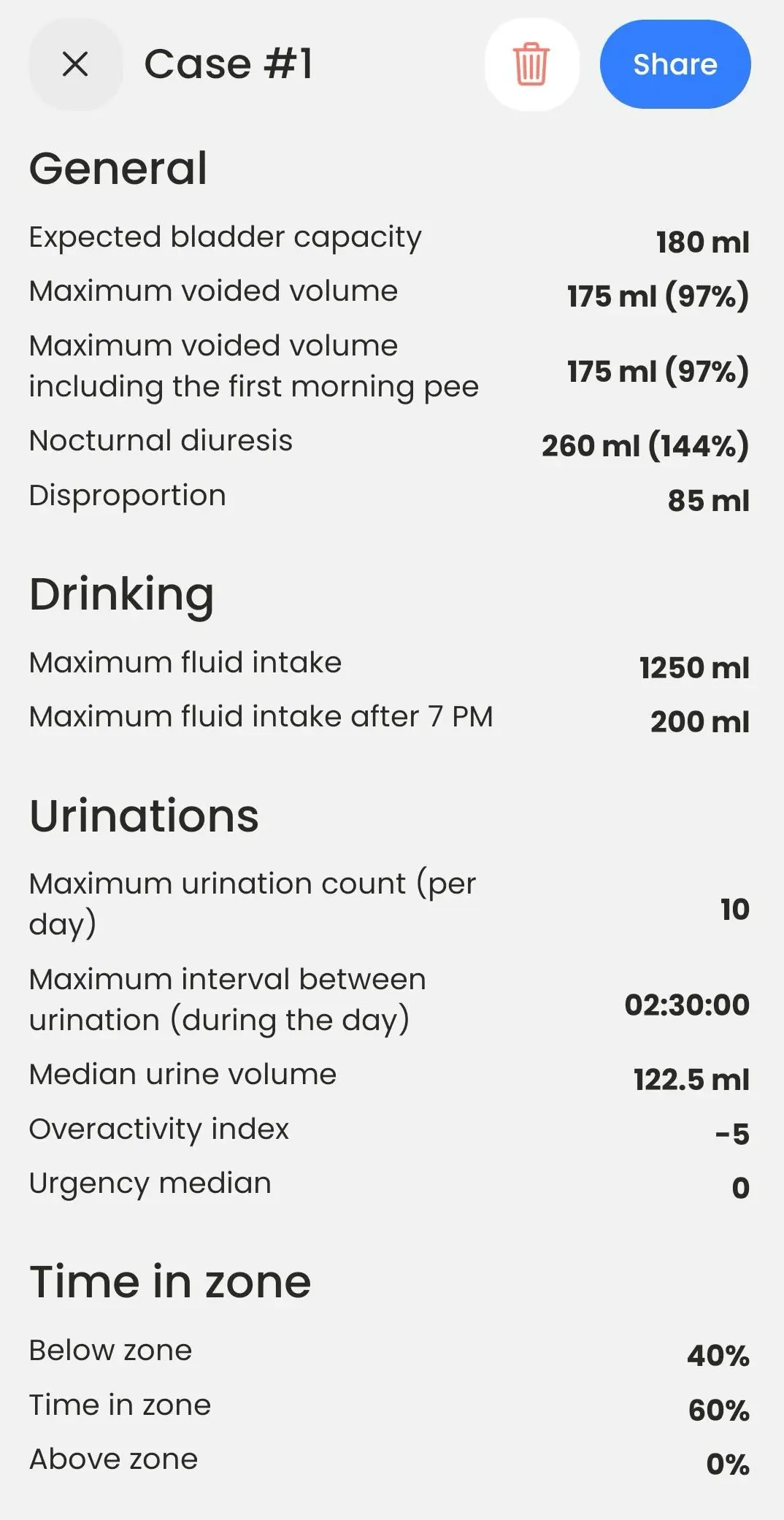
In the app, Understanding your data explains each measurement in plain language, so families can understand what the Summary is showing — including terms such as nocturnal diuresis.
Why this distinction matters
Bedwetting can look the same from the outside while having different reasons behind it. In primary enuresis, two important factors are how much urine is produced during the night and how much the bladder can hold. Clinical guidelines use both when assessing bedwetting and choosing appropriate treatment.1,2
In this boy, the bladder can hold a normal amount, but more urine is produced overnight than it can store. If the Diary had instead shown a small bladder capacity, the next steps would be different. The symptom — a wet bed — would look exactly the same.
That is why measuring matters: the Diary can reveal something that the history alone cannot.
Which treatment, and whether any is needed, is a decision for the treating doctor. Nothing on this page is a prescription, a dose or a schedule.
What Checkpoint highlighted
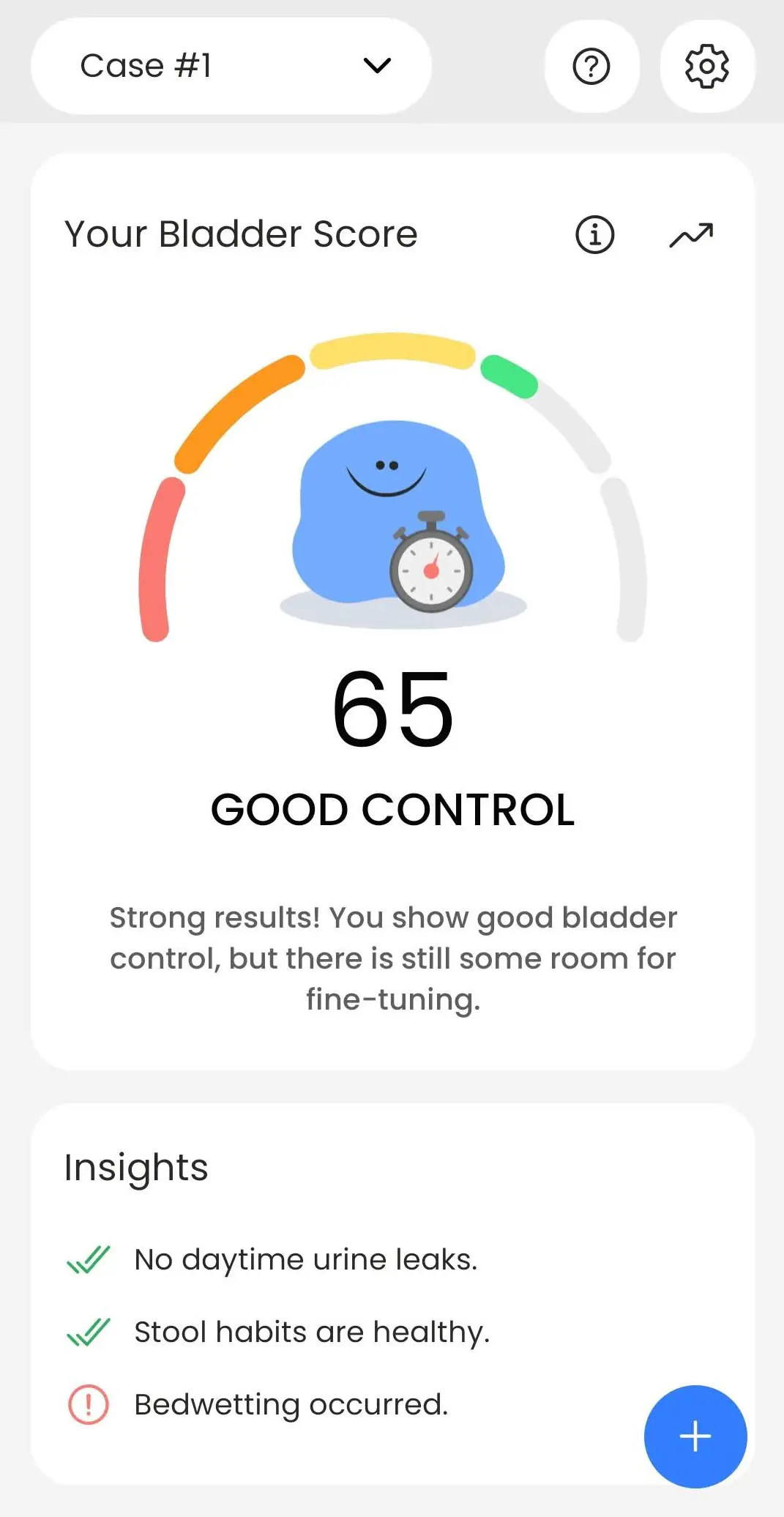
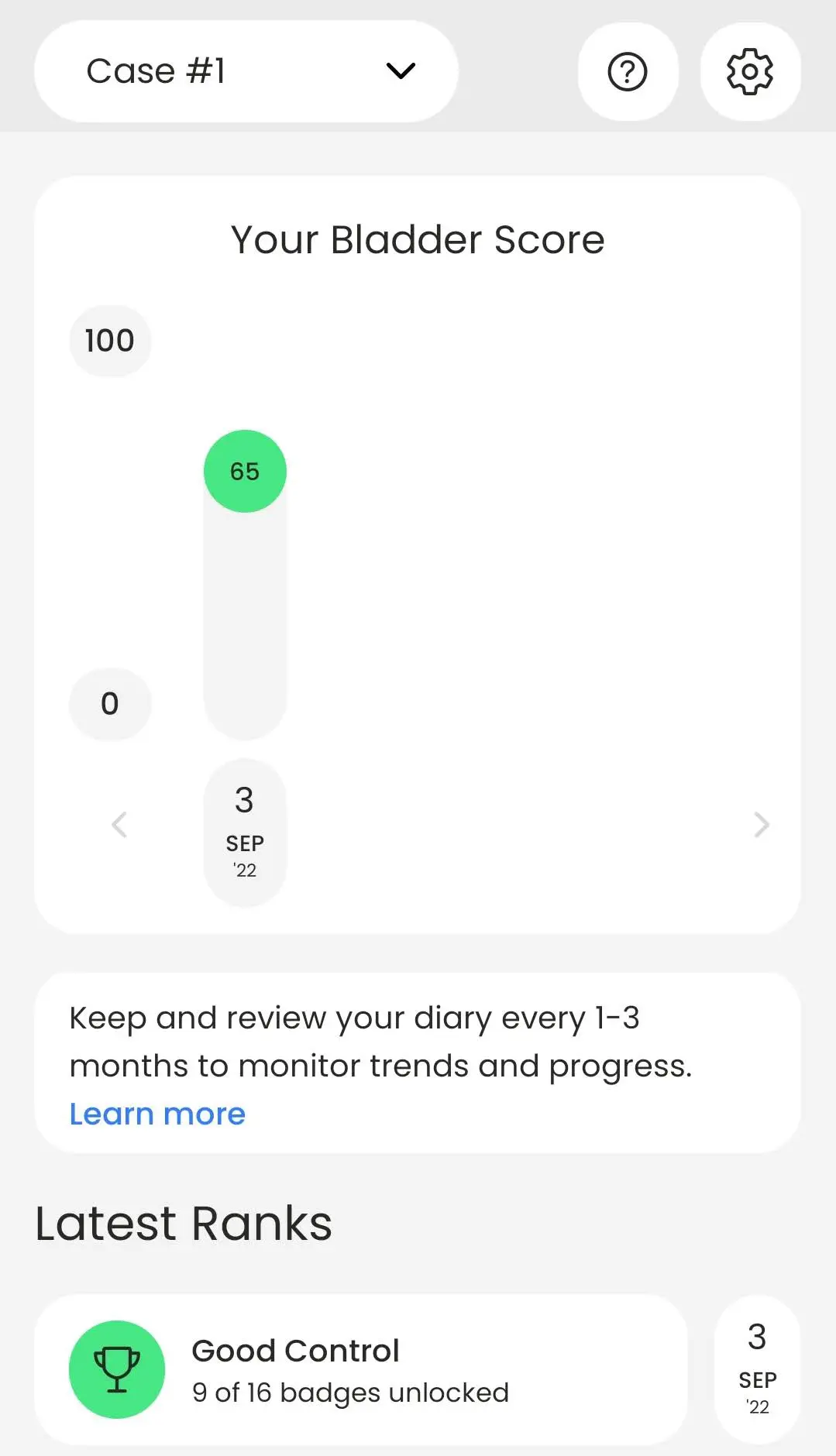
Your Bladder Score for this diary came out at 65 — good overall control, which fits a boy with no daytime symptoms at all. The score does not hide the problem, though: bedwetting is flagged straight away, next to what is going well.
The Insights show where to look next. Total fluid intake is low for his size, most of what he does drink arrives in the evening, and morning hydration is almost absent.
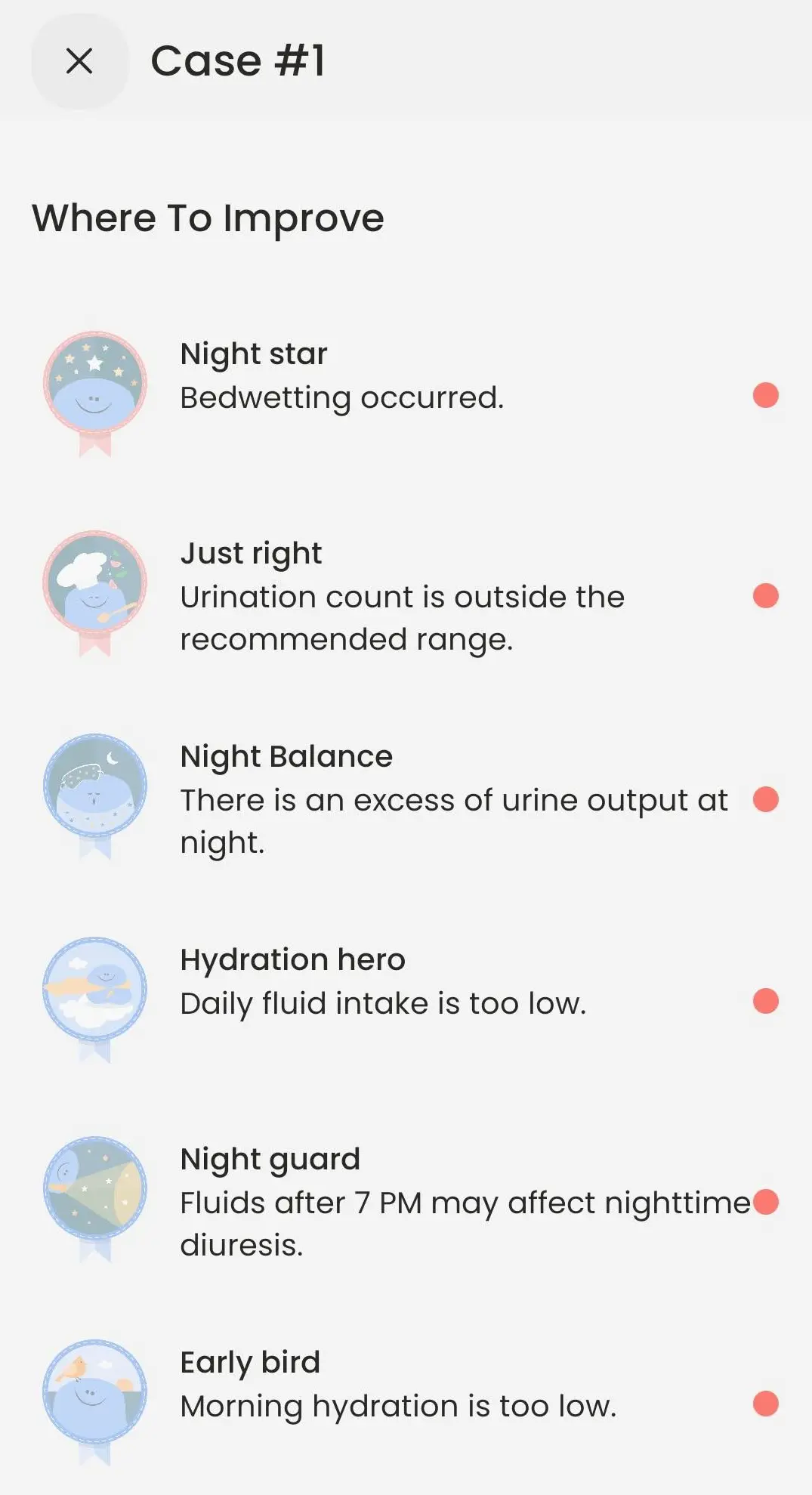
That pattern tends to be self-reinforcing. A child who drinks too little during the day is genuinely thirsty by evening, drinks then, and produces the urine overnight. The evening drinking is a symptom of the daytime habit, not a lapse of discipline.
What Coach suggested
The training plan follows directly from what Checkpoint highlighted, and none of it is exotic: reach a adequate daily volume, and move it earlier in the day. Coach set out roughly 1.5 litres a day divided into portions — about 500 ml by noon, 500 ml by 4 PM, and 500 ml by 7 PM. These are minimums to reach, not ceilings; drinking more than the plan is fine.
The starting point is the morning. It is best to open the day with a drink the child actually likes, because the feeling of thirst follows intake rather than preceding it. After 4 PM the advice narrows to water only — milk, juices and tea are more likely to increase urine production or irritate the bladder.
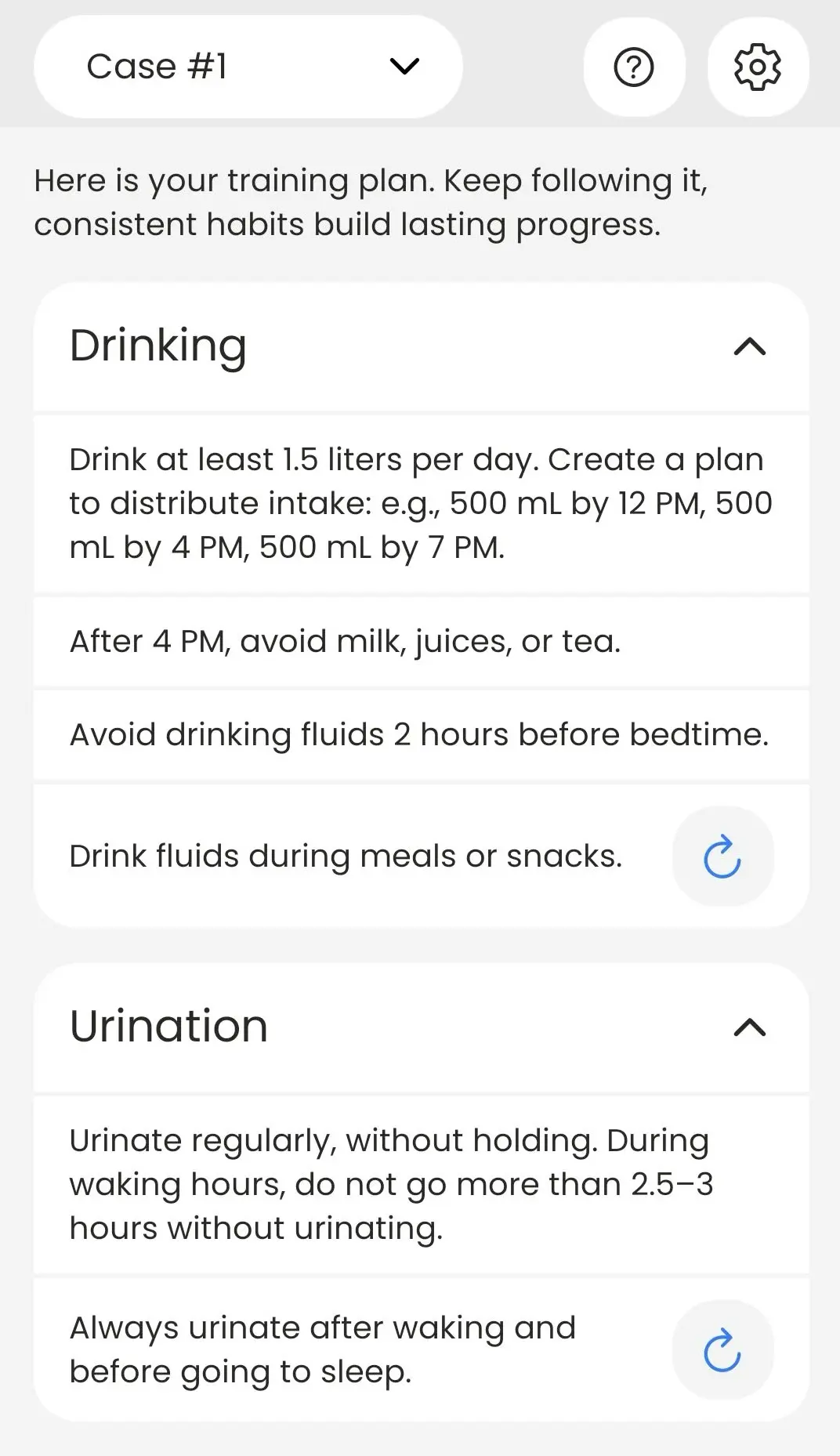
On the urination side there was little to correct: he already pees regularly during the day and empties before bed. Coach keeps these healthy habits in the plan.
The training plan gives the family a healthier routine to work from and can support the treatment recommended by their doctor.
Following it over time
Changing habits takes time, and it can be difficult to judge progress from memory alone. Keep the diary again in one to three months and compare. Trends lines up the scores from each Checkpoint, so changes in bladder habits become visible as a line rather than as a feeling.
What the doctor receives
By keeping a bladder diary with BeDRY, families can understand what is happening, see which habits may need attention, and use Coach to build healthier routines at home. Trends then helps them follow how those habits change over time.
The family can also share the Summary directly from the app. What the doctor receives is not simply he wets every night, but a measured bladder capacity, measured night-time urine production, the difference between them, and the child’s drinking pattern — presented in the same units and the same order every time. The consultation can start with the findings, rather than spending the first part trying to reconstruct them from memory.
Every case here started with a bladder diary. Start with the free BeDRY Bladder Diary. After two days and three nights, Checkpoint helps you understand what you’ve recorded, Coach provides practical steps to follow at home, and Trends helps you see what changes over time.
Get Started — FreeCheckpoint and Coach are educational features, not medical advice. Consult a healthcare professional for medical decisions.
References
- Nevéus T, Fonseca E, Franco I, et al. Management and treatment of nocturnal enuresis — an updated standardization document from the International Children’s Continence Society. J Pediatr Urol. 2020;16(1):10–19. doi:10.1016/j.jpurol.2019.12.020
- Vande Walle J, Rittig S, Bauer S, et al. Practical consensus guidelines for the management of enuresis. Eur J Pediatr. 2012;171(6):971–983. doi:10.1007/s00431-012-1687-7
- Austin PF, Bauer SB, Bower W, et al. The standardization of terminology of lower urinary tract function in children and adolescents: update report from the Standardization Committee of the International Children’s Continence Society. Neurourol Urodyn. 2016;35(4):471–481. doi:10.1002/nau.22751
Written, reviewed and explained by Dr. Slaven Abdović, MD, PhD, pediatric nephrologist at Children’s Hospital Zagreb and founder of BeDRY, from his own clinical perspective and experience together with the published guidelines cited above. The case is constructed for teaching and does not describe a real person. Last reviewed 19 August 2026.