 BeDRY
BeDRY
This case is fictional. It is constructed by Dr. Slaven Abdović from common presentations seen in an incontinence clinic. The screenshots use diaries created specifically for these examples; no real patient data is used. Any resemblance to a real person is entirely coincidental. The interpretation reflects his clinical experience alongside published guidelines. The example is educational and not a substitute for assessment by your own doctor.
In short
- From age of seven presented with urgency five or six times a day, daytime urine leaks, pads worn to hide them at school, and new-onset bedwetting.
- The history suggested a small bladder. The diary showed the opposite — bladder capacity was exactly what was expected for her age.
- What stood out instead was the pattern shown in BeDRY Diary Summary: eleven urinations a day and an overactivity index of 41 - pointing to overactive bladder.
- Checkpoint helped make sense of these findings, while Coach focused on practical changes the family could work on at home: drinking enough, avoiding provocative drinks, urinating regularly before urgency appeared, and improving toilet posture.
What the parents described
A nine-year-old girl with successful potty training at three and good control until she turned seven. Since then: urgency five or six times a day, and once it starts she can hold for about a minute before she leaks. The urge never settles on its own — she always runs. Between visits to the toilet the parents report intervals of only about two hours. There is at least one wet episode every day. Some of the leaks are described as a dribble that appears after she has finished on the toilet, which is why she started wearing pads and keeping the whole thing hidden from her classmates. Bedwetting has returned after years of dry nights. Her stools are Bristol type 3 and she goes regularly and does not strain.
From this history, a small bladder would seem an obvious explanation. But symptoms alone cannot tell us how much her bladder actually holds. That is what the bladder diary can measure.
What the diary showed
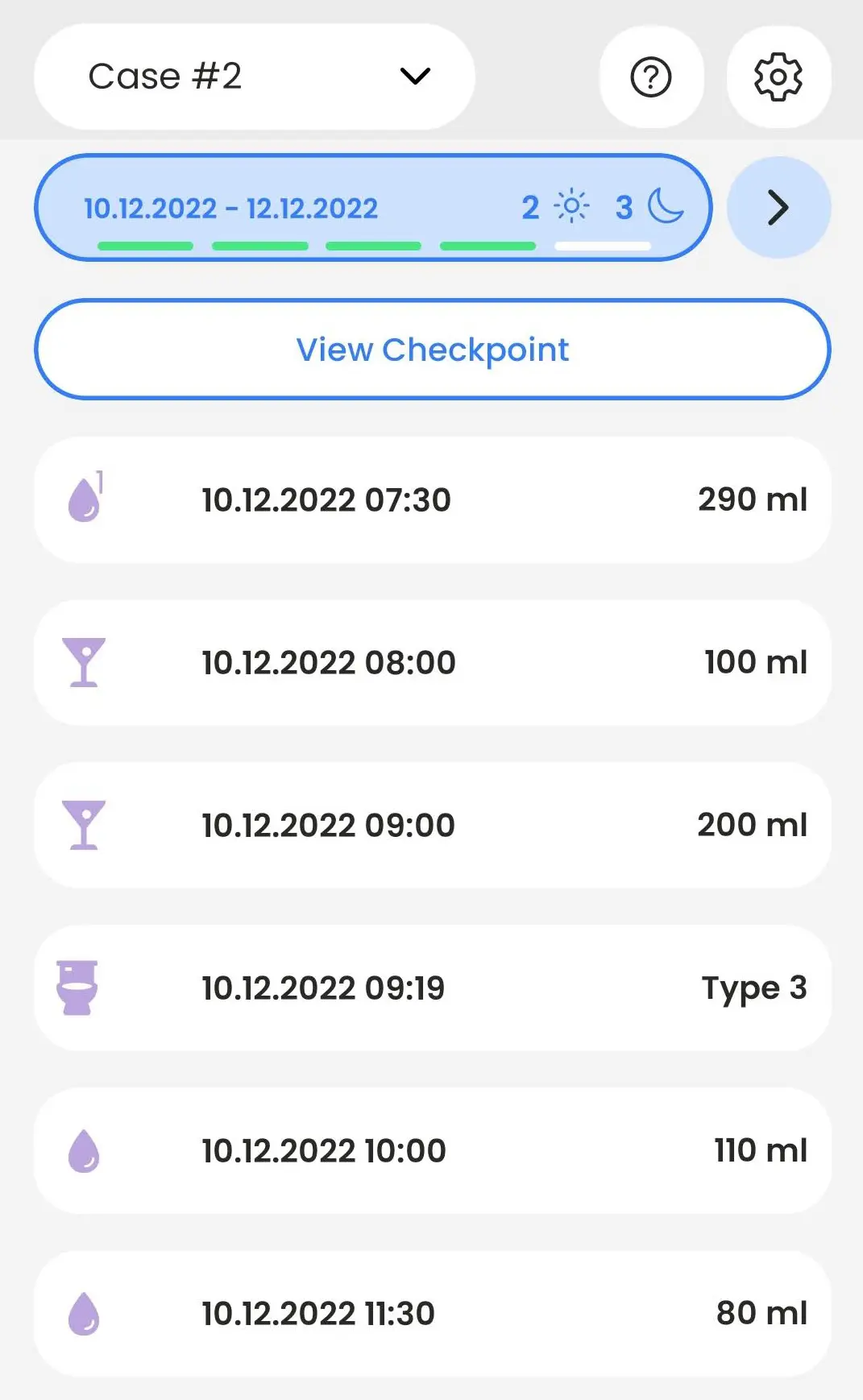
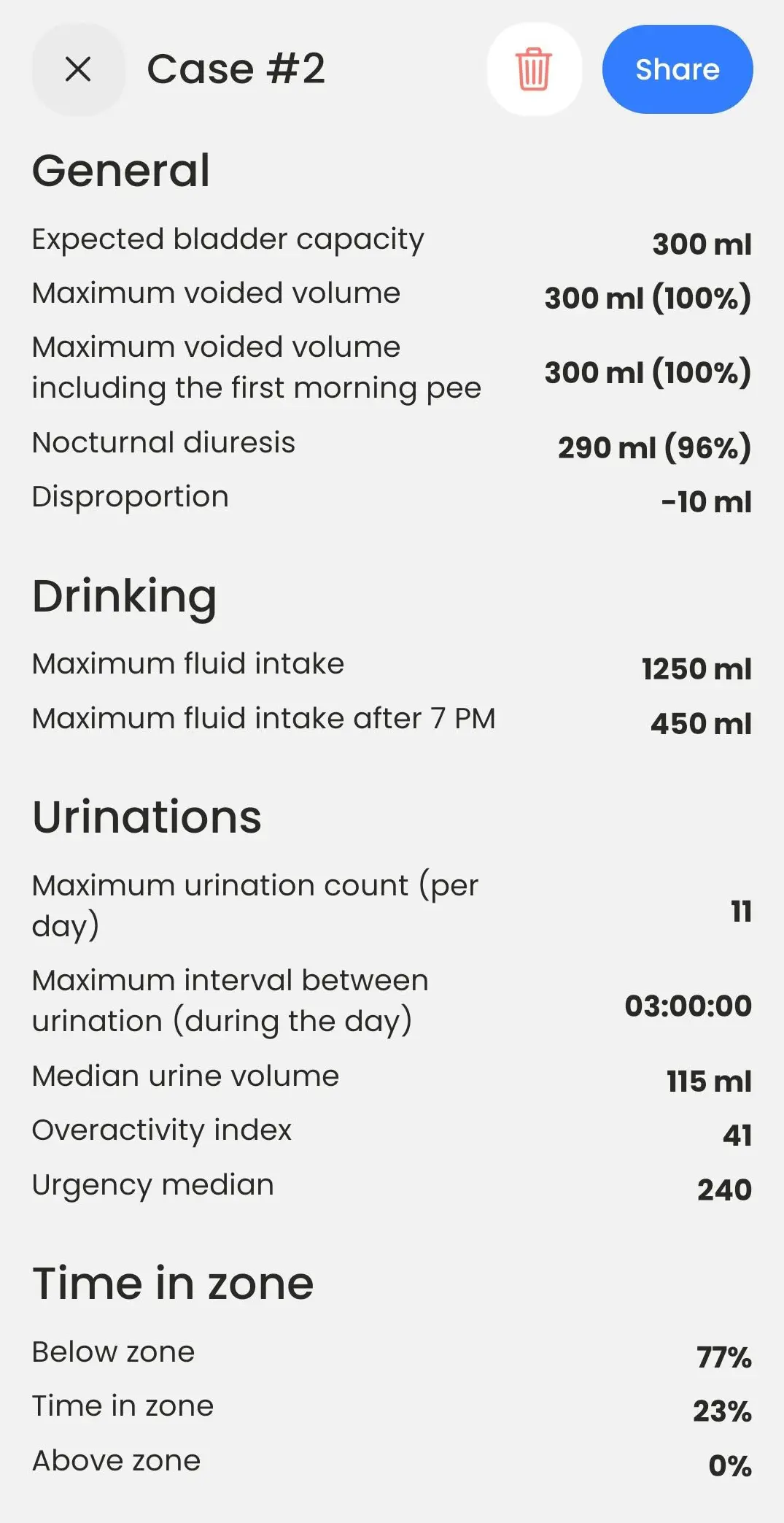
| Expected bladder capacity for age | 300 ml |
| Largest measured void | 300 ml (100%) |
| Night-time urine production | 290 ml (96%) |
| Mismatch between the two | −10 ml |
| Voids per day | 11 |
| Median void volume | 115 ml |
| Overactivity index | 41 |
| Median urgency score | 240 |
| Total daily fluid intake | 1250 ml |
| Fluid intake after 7 PM | 450 ml |
Capacity is not the problem. The maximum voided volume is 300 ml, exactly the normal bladder capacity expected for her age, and night-time production of 290 ml sits just below it — there is no imbalance to explain the wet nights the way there was in the first case. So what is causing incontinence every day and every night?
The answer is in the rest of the table. She empties eleven times a day, and the typical urination volume is 115 ml — a bladder that can hold 300 ml being emptied at just over a third of that, again and again. The overactivity index comes out at 41 - what does this mean?
The overactivity index
In overactive bladder, urgency can appear before the bladder is actually full. The child therefore urinates frequently at smaller volumes and may leak before reaching the toilet — even though the bladder itself may be capable of holding a normal amount.
The overactivity index is calculated from the bladder diary alone. In a study I published in 2022, the index was significantly correlated with maximum cystometric capacity measured during invasive urodynamics. An index above 22 was associated with questionnaire-based diagnosis of overactive bladder, with an AUC of 0.858.1
Her index was 41. It gives an objective confirmation of the pattern her parents had been describing.
What Checkpoint highlighted
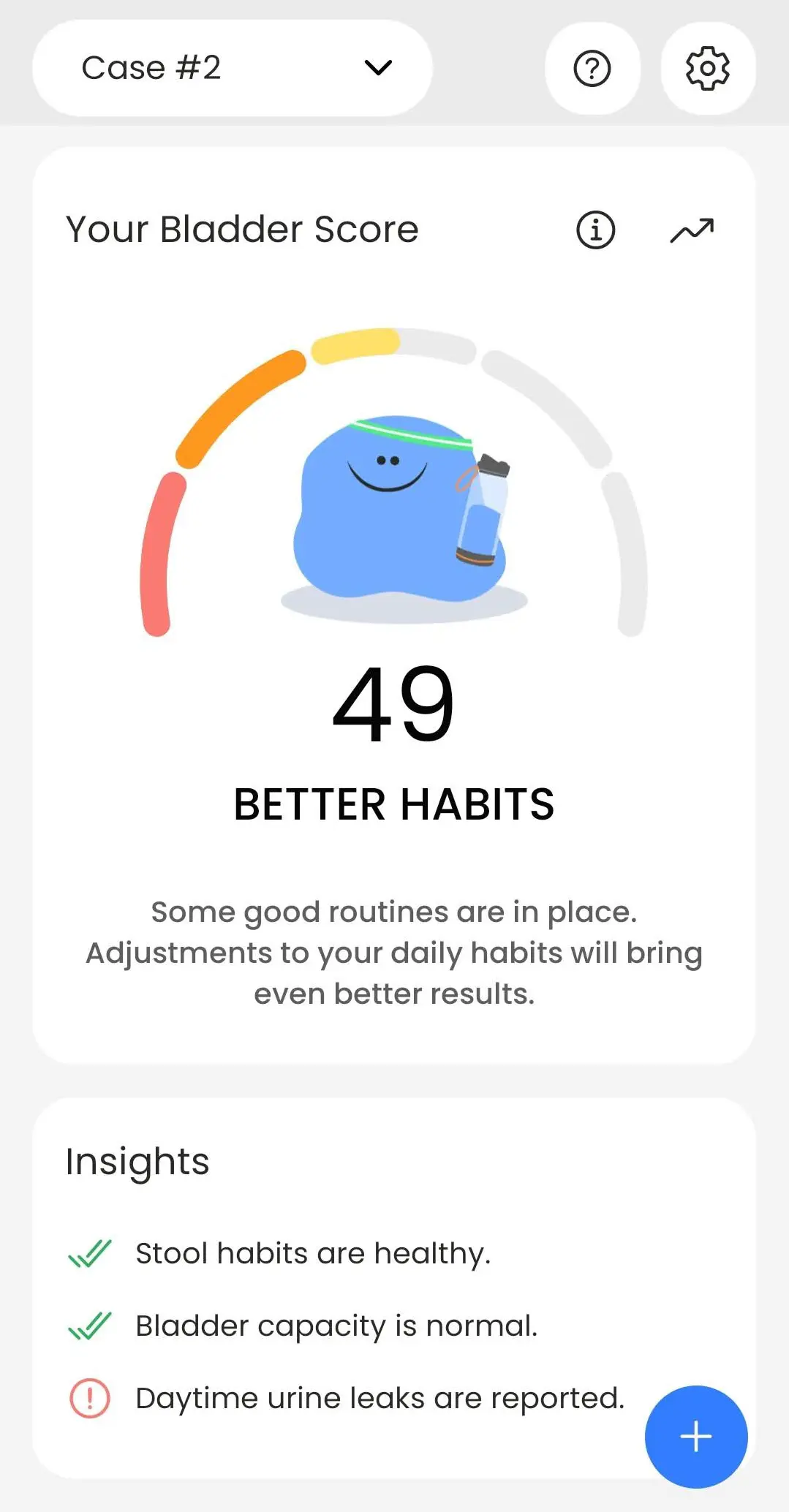
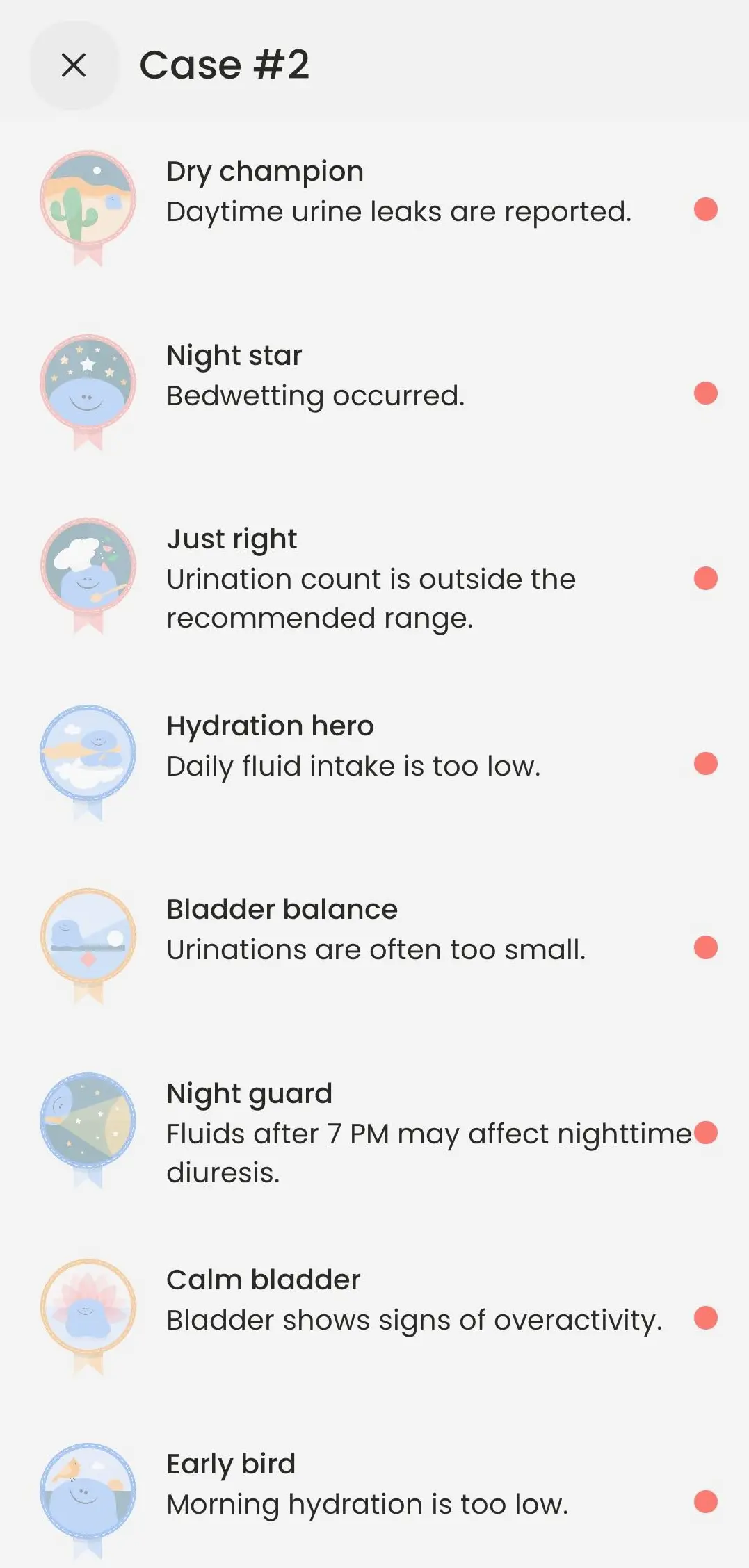
A score of 49 with the label Better Habits gives an overall picture, while the Insights show where attention is needed. Bladder capacity is confirmed as normal, while the daytime leaks, frequent small voids, low daily fluid intake and signs of overactivity are highlighted together.
What Coach suggested
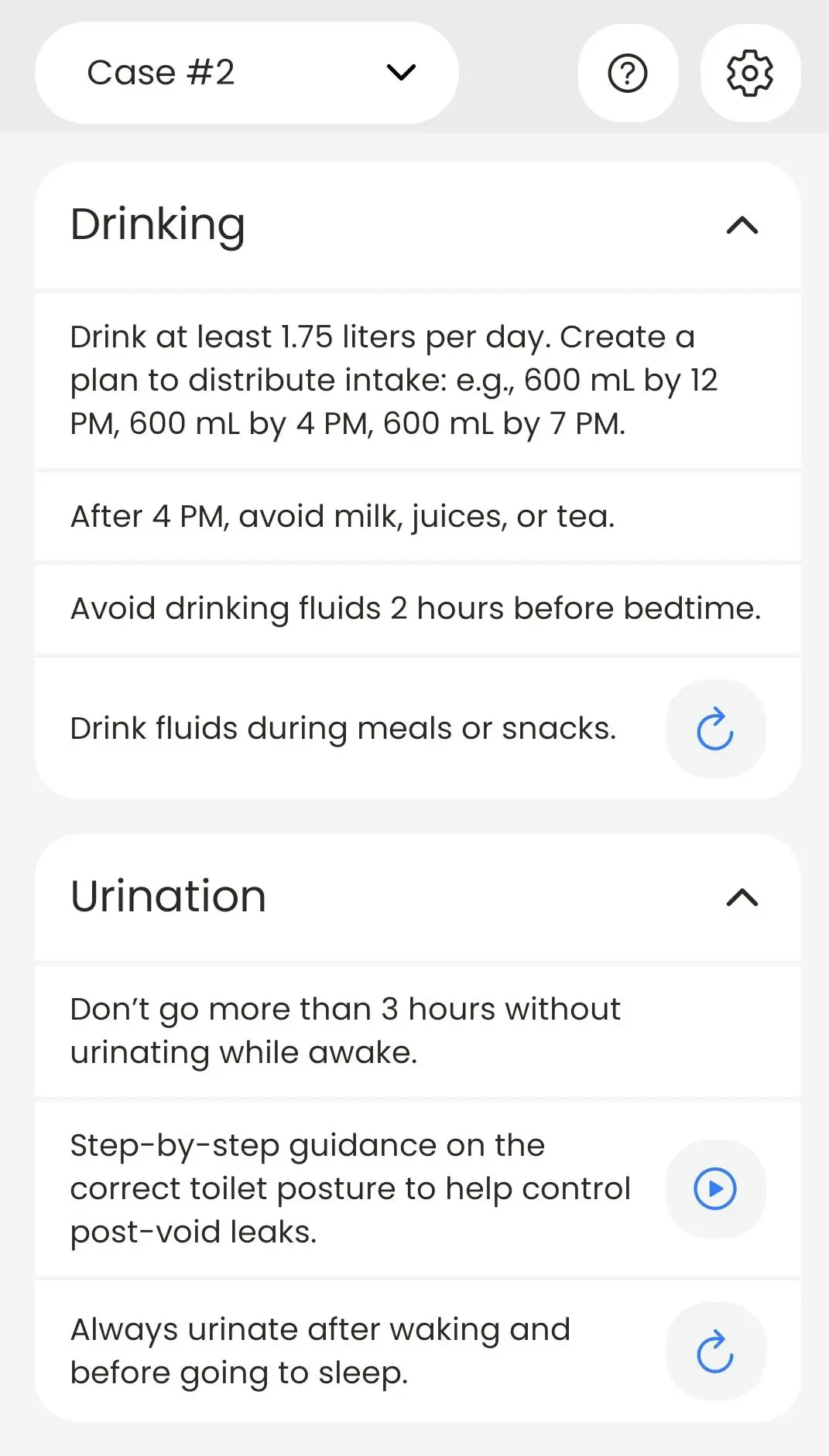
The training plan follows directly from what Checkpoint highlighted. The first change is drinking: Coach set about 1.75 litres a day, divided across the day. This can feel counter-intuitive because children with urgency often start drinking less in an attempt to avoid leaks. But drinking too little can produce concentrated urine and does not build a healthy bladder routine.
On urination, the instruction is specific and it is the opposite of what these children usually do: go regularly, on a schedule, before the urge appears. Waiting for the signal means racing it.
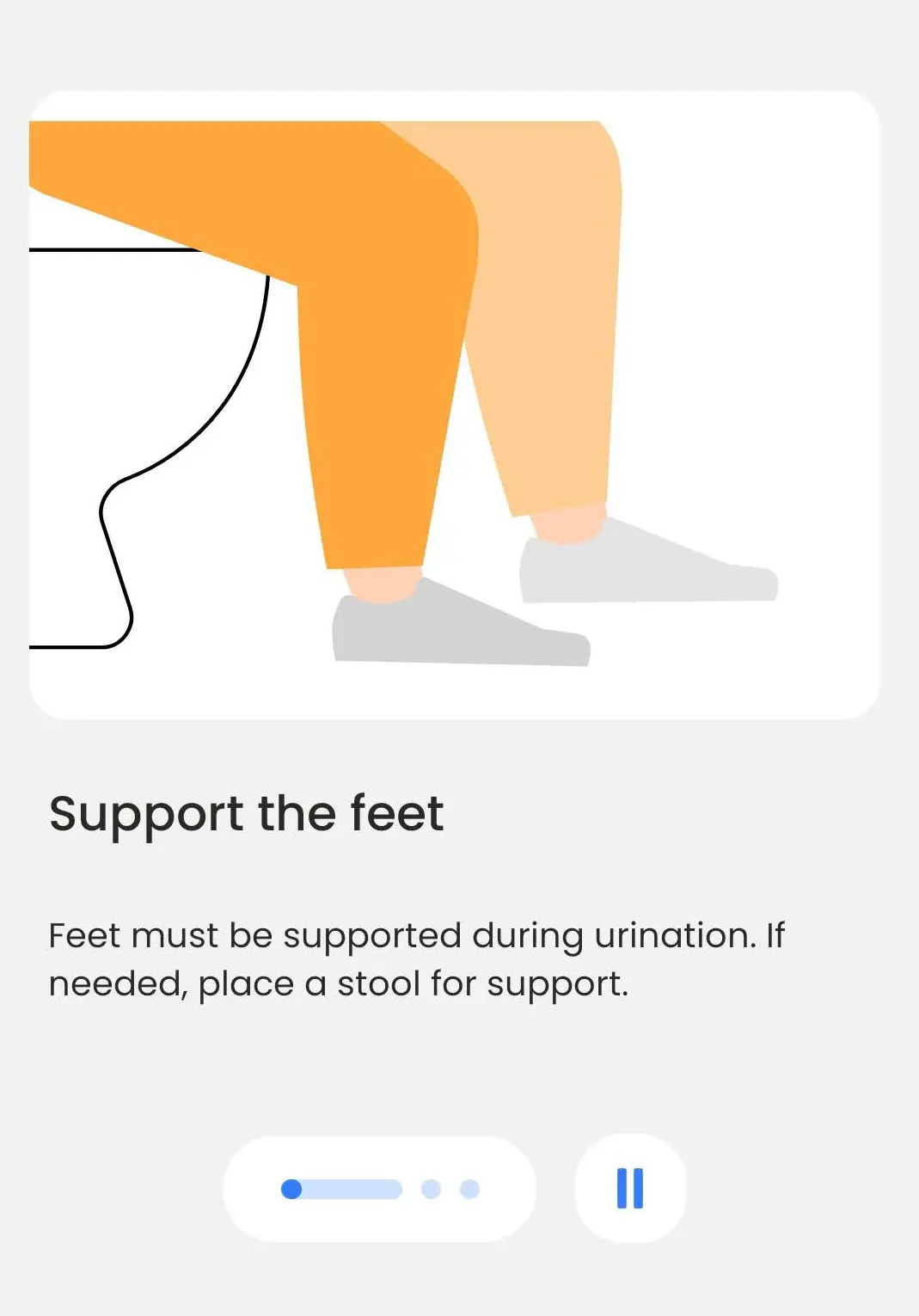
Because some leaks appeared after she had finished urinating, Coach also provided step-by-step video guidance on proper toilet posture - an important tip to prevent post-void dribble in girls.

Habits alongside treatment
In my clinical practice, I consider these bladder habits an important part of managing cases like this, including when medication is needed. Adequate drinking, regular urinations and good toilet habits provide the routine on which other treatment can build. That reflects my clinical experience rather than a measured treatment outcome from BeDRY.
Improvement also takes time. Overactive bladder is rarely something I expect to resolve in one or two months; six months or longer may be needed before the overall result can be judged. Children with persistent symptoms of overactive bladder should also be assessed by a doctor, including urine testing, because urinary tract infection and diabetes can produce similar symptoms.
Following it over time
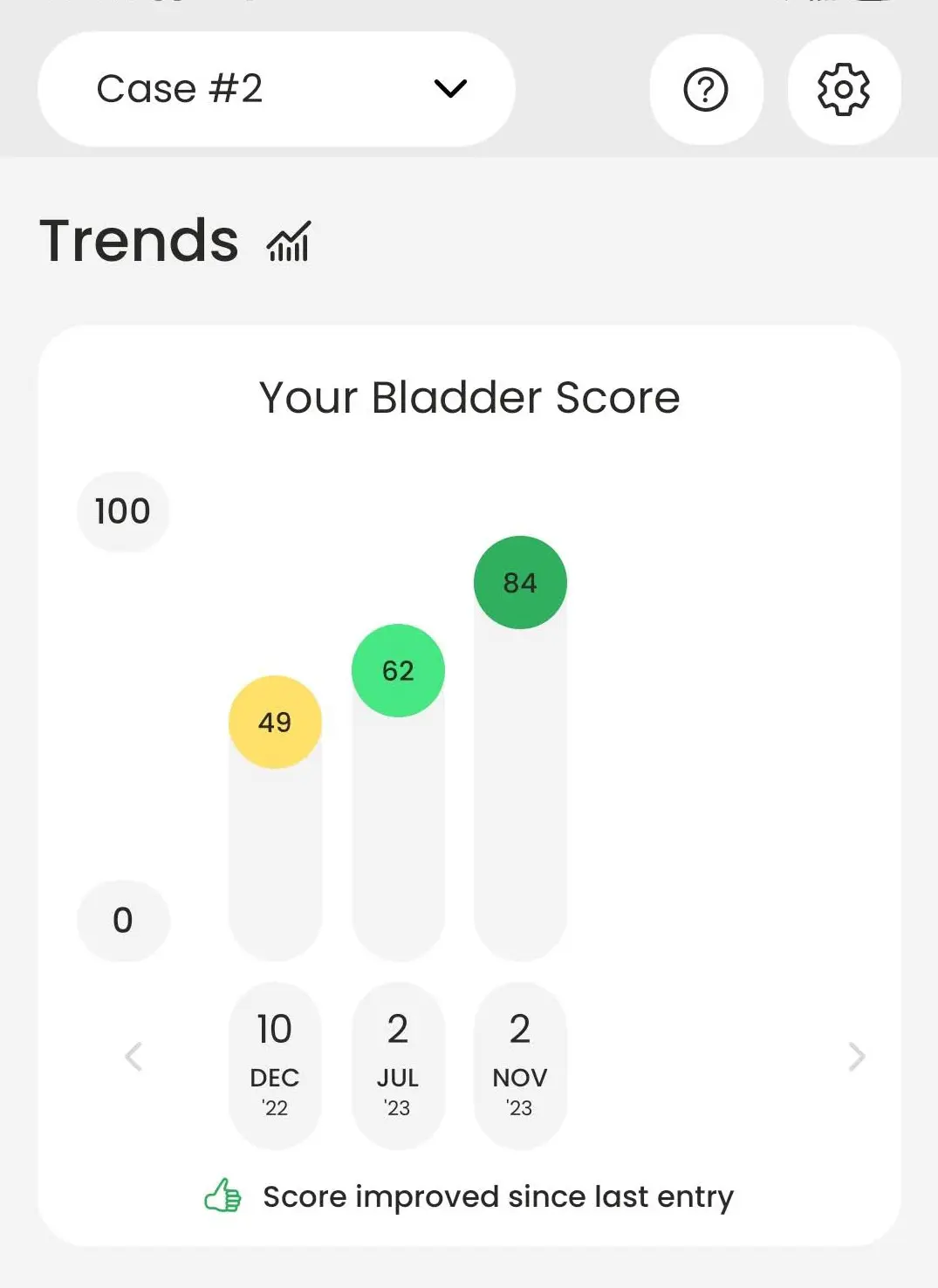
This is where repeating the diary becomes useful. Changes in urgency, voiding frequency, drinking patterns and bladder control may happen gradually enough to be difficult to judge from memory. Repeating the diary and Checkpoint gives the family the same measurements again, while Trends shows how the overall pattern changes over time.
Progress can be slow enough to be invisible from diary to diary — Trends makes it easier to see over months and check which habits improved and which areas still need focus and work.
For you — and for your doctor
By keeping a bladder diary with BeDRY, families can understand what is happening, see which habits may need attention, and use Coach to build healthier routines at home. Trends then helps them follow how those habits change over time.
The family can also share the Summary directly from the app. In this case, the doctor receives more than a description of urgency and daily leaks: the Summary shows normal bladder capacity alongside eleven voids a day, small typical voids and an overactivity index of 41. The consultation can start with the findings rather than trying to reconstruct the pattern from memory.
Every case here started with a bladder diary. Start with the free BeDRY Bladder Diary. After two days and three nights, Checkpoint helps you understand what you’ve recorded, Coach provides practical steps to follow at home, and Trends helps you see what changes over time.
Get Started — FreeCheckpoint and Coach are educational features, not medical advice. Consult a healthcare professional for medical decisions.
References
- Abdović S, Bahtijarević Z, Đapić T, et al. Overactivity index: a noninvasive and objective outcome measure in overactive bladder in children. J Pediatr Urol. 2022;18(3):352.e1–352.e7. doi:10.1016/j.jpurol.2022.03.012
- Chang SJ, Van Laecke E, Bauer SB, et al. Treatment of daytime urinary incontinence: a standardization document from the International Children’s Continence Society. Neurourol Urodyn. 2017;36(1):43–50. doi:10.1002/nau.22911
- Nieuwhof-Leppink AJ, Hussong J, Chase J, et al. Definitions, indications and practice of urotherapy in children and adolescents: a standardization document of the International Children’s Continence Society. J Pediatr Urol. 2021;17(2):172–181. doi:10.1016/j.jpurol.2020.11.006
- Austin PF, Bauer SB, Bower W, et al. The standardization of terminology of lower urinary tract function in children and adolescents: update report from the Standardization Committee of the International Children’s Continence Society. Neurourol Urodyn. 2016;35(4):471–481. doi:10.1002/nau.22751
Written, reviewed and explained by Dr. Slaven Abdović, MD, PhD, pediatric nephrologist at Children’s Hospital Zagreb and founder of BeDRY, from his own clinical perspective and experience together with the published guidelines cited above. The case is constructed for teaching and does not describe a real person. Last reviewed 19 August 2026.